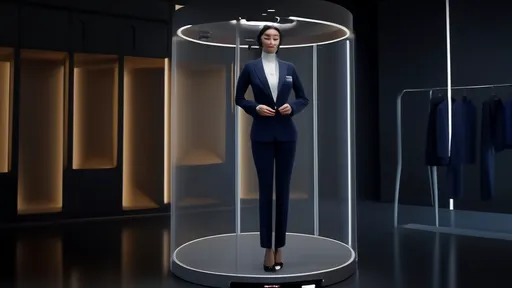
In the bustling landscape of fashion technology, virtual try-on solutions have emerged as one of the most anticipated innovations, promising to revolutionize how consumers shop for clothing online. Yet, despite significant advancements in augmented reality (AR), 3D modeling, and artificial intelligence (AI), the dream of a flawless virtual fitting experience remains tantalizingly out of reach. The journey toward perfection is fraught with technical, practical, and even psychological hurdles that researchers and developers are racing to overcome.
At the heart of virtual try-on technology lies the challenge of accurately simulating how fabric behaves on a human body. Unlike rigid objects, textiles drape, fold, stretch, and compress in ways that are incredibly difficult to replicate digitally. Early iterations of virtual fitting rooms relied on simplistic overlays of garment images onto user photos, resulting in comically unrealistic representations that did little to inspire consumer confidence. Today, more sophisticated physics-based simulation engines attempt to mimic fabric properties such as weight, elasticity, and friction. However, these simulations require immense computational power and still struggle with complex materials like silk or heavily structured items like tailored blazers. The subtleties of how a garment interacts with different body shapes—accommodating curves, bulges, and movements—add layers of complexity that even state-of-the-art systems find daunting.
Another critical bottleneck is the creation of precise digital doubles of both garments and consumers. For clothing, this typically involves 3D scanning or photogrammetry of each item, a process that is time-consuming and expensive when applied at scale. Each garment must be captured in multiple positions to account for various poses and movements, and variations in size and color further multiply the workload. On the user side, generating an accurate avatar is equally challenging. While smartphone cameras and depth sensors have improved, they often fail to capture exact body measurements without specialized hardware or manual input. Issues like lighting conditions, clothing worn during scanning, and posture inconsistencies can lead to avatars that are slightly off—enough to make a virtually tried-on garment look ill-fitting or unflattering. Until automated, high-fidelity digitization becomes affordable and effortless, this step will remain a significant barrier to widespread adoption.
The role of artificial intelligence in virtual try-ons cannot be overstated, yet it introduces its own set of limitations. Machine learning models trained on vast datasets of body types and garments can predict fit and drape with increasing accuracy, but they are only as good as the data they are fed. Biases in training data—overrepresenting certain body shapes, ethnicities, or ages—can lead to poor performance for underrepresented groups. Moreover, AI systems sometimes produce plausible but incorrect results, such as smoothing over wrinkles or ignoring fabric tension in a way that looks convincing at a glance but fails under scrutiny. These "hallucinations" undermine trust, especially when the stakes involve personal body image and financial decisions. Ensuring that AI recommendations are not only accurate but also ethical and inclusive is an ongoing struggle for developers.
Beyond pure technical performance, user experience and psychological factors play a crucial role in the adoption of virtual try-on tools. Shoppers are not just looking for a rough approximation; they want to feel confident that what they see on screen will translate to reality. Current technology often falls short in conveying tactile sensations—the weight of denim, the softness of cashmere, or the stiffness of starched cotton—which are integral to the shopping experience. Additionally, the way garments are presented digitally can influence perception; a virtually tried-on item might appear distorted or unappealing due to rendering artifacts, lighting mismatches, or unnatural poses. Overcoming the "uncanny valley" effect, where close-but-imperfect simulations feel eerie or untrustworthy, requires not only better graphics but also a deeper understanding of human perception and emotion.
Looking ahead, the path to perfect virtual try-ons will likely involve a convergence of technologies. Advances in real-time rendering, powered by cloud computing and edge devices, could make complex physics simulations more accessible. Breakthroughs in materials science might lead to digital twins that behave even more like their physical counterparts. Meanwhile, the integration of haptic feedback devices—though still nascent—could someday simulate the feel of fabrics, adding a missing sensory dimension. Industry collaboration is also key; standardized sizing databases, shared garment scans, and open-source avatars could reduce duplication of effort and accelerate progress.
Nevertheless, it is important to temper expectations with realism. Perfect virtual try-ons may never be achieved in an absolute sense, just as no physical fitting room guarantees satisfaction. The goal is not perfection but sufficiency—creating experiences that are reliable enough to reduce returns, enhance convenience, and bring joy to online shopping. As developers chip away at each technical bottleneck, we move closer to a future where clicking "try it on" is as natural and trustworthy as slipping into a dressing room. Until then, the quest continues, driven by equal parts innovation and perseverance.

By /Aug 21, 2025
By /Aug 21, 2025

By /Aug 21, 2025

By /Aug 21, 2025

By /Aug 21, 2025
By /Aug 21, 2025

By /Aug 21, 2025

By /Aug 21, 2025
By /Aug 21, 2025
By /Aug 21, 2025

By /Aug 21, 2025

By /Aug 21, 2025

By /Aug 21, 2025
By /Aug 21, 2025

By /Aug 21, 2025
By /Aug 21, 2025
By /Aug 21, 2025
By /Aug 21, 2025

By /Aug 21, 2025
By /Aug 21, 2025