In an era where artificial intelligence continues to reshape industries, the realm of fashion education stands at a critical crossroads. The question is no longer whether automation will impact creative fields, but how educators can cultivate the uniquely human elements of design that machines cannot replicate. While technical skills remain important, the future of fashion pedagogy must shift toward nurturing intuition, emotional intelligence, and conceptual thinking—the very qualities that define enduring creativity.
The traditional fashion school curriculum has long emphasized technical mastery: pattern drafting, construction techniques, and textile knowledge. These skills, while fundamental, are increasingly susceptible to automation. Advanced software can now generate patterns with precision, simulate fabric behavior, and even suggest color palettes based on algorithmic trends. What algorithms cannot do is understand the cultural nuance behind a garment, the emotional resonance of a particular silhouette, or the storytelling that transforms clothing into cultural artifacts.
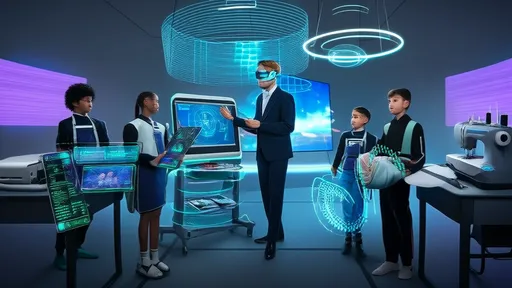
Forward-thinking institutions are already reimagining their approach by creating learning environments that prioritize human-centric creativity. Instead of focusing solely on technical execution, they're developing courses that explore fashion through anthropology, psychology, and even neuroscience. Students might spend as much time studying consumer behavior and cultural semiotics as they do mastering sewing techniques. This interdisciplinary approach helps designers understand why certain designs resonate emotionally—knowledge that cannot be codified into algorithms.
Another significant shift involves teaching students to embrace imperfection and intuition. Where machines optimize for efficiency and perfection, human creativity often thrives through experimentation and even failure. Progressive educators are creating safe spaces for students to take creative risks, encouraging projects that might not result in commercially viable products but which develop the designer's unique voice. These experimental processes help students develop their artistic intuition—the ability to make creative leaps that defy logical explanation.
The role of mentorship becomes increasingly crucial in this new educational paradigm. While AI can provide technical feedback on stitch quality or pattern accuracy, only human mentors can guide students in developing their creative identity. The most effective fashion educators serve not just as instructors but as creative catalysts, helping students discover their unique perspective and voice. This human connection—the transfer of wisdom, taste, and creative philosophy—represents perhaps the most automation-resistant aspect of fashion education.
Ethical and sustainable thinking represents another domain where human creativity outperforms automation. While AI can optimize supply chains or calculate environmental impact, it cannot make value judgments about what constitutes ethical fashion. Students need to develop the critical thinking skills to navigate complex questions about cultural appropriation, labor practices, and environmental responsibility. These considerations require moral reasoning and cultural sensitivity—capabilities that remain firmly in the human domain.
Storytelling has emerged as perhaps the most vital skill in the automation-resistant fashion curriculum. Great fashion transcends mere clothing; it communicates identity, culture, and narrative. Educators are helping students develop their storytelling abilities through various mediums—from traditional sketchbooks to digital content creation. Students learn to articulate the inspiration behind their collections, connect their work to broader cultural conversations, and build emotional connections with their audience. This narrative dimension gives fashion its cultural relevance and commercial value.
The physical experience of fashion—how garments feel, move, and interact with the body—represents another area where human sensitivity outperforms digital simulation. While virtual try-on technology continues to improve, the subtle nuances of fabric hand, weight, and drape still require physical interaction. Educational programs are doubling down on tactile experiences, encouraging students to develop their sensory intelligence through extensive material experimentation and hands-on prototyping.
Collaboration across disciplines has become essential for developing automation-resistant creative skills. Fashion students increasingly work with counterparts in technology, business, and even science to tackle complex challenges. These collaborations teach students to communicate across specialties, integrate diverse perspectives, and develop solutions that balance creative vision with technical feasibility. The ability to work effectively in diverse teams—understanding different languages and perspectives—remains a distinctly human capability.
Perhaps most importantly, fashion education must help students develop their creative confidence—the willingness to trust their instincts and defend their vision. In an industry increasingly driven by data and algorithms, the most valuable designers will be those who can articulate why their intuitive choices matter. This requires cultivating not just technical skill but artistic conviction, teaching students to balance market awareness with creative integrity.
The future of fashion education isn't about rejecting technology but about rebalancing the curriculum to emphasize human capabilities that complement rather than compete with automation. The most successful programs will create learning environments that feel less like technical training grounds and more like creative incubators—spaces where students can develop their unique voice, emotional intelligence, and cultural awareness. These human qualities will define the next generation of fashion innovation, ensuring that creativity remains our most valuable asset in an automated world.
As educational institutions navigate this transition, they're discovering that the most valuable lessons often happen outside traditional classrooms. Study abroad programs, industry collaborations, and even failure analysis become crucial components of a modern fashion education. By exposing students to diverse perspectives and real-world challenges, educators help develop the adaptability and creative resilience that automation cannot duplicate.
The transformation of fashion education reflects broader changes across creative industries. As automation handles increasingly sophisticated technical tasks, human creators must focus on what makes our creativity unique: its emotional depth, cultural context, and intuitive spark. The fashion educators who succeed will be those who can articulate and cultivate these human qualities, preparing students not just to compete with technology but to collaborate with it in creating meaningful, culturally relevant work.
Ultimately, the question isn't whether fashion schools can teach automation-resistant creativity, but whether they can create environments where such creativity can flourish. This requires rethinking everything from curriculum design to faculty development, from physical spaces to assessment methods. The schools that embrace this challenge will define the future of fashion—not just as a commercial industry but as a form of cultural expression and human connection.

By /Aug 21, 2025
By /Aug 21, 2025

By /Aug 21, 2025

By /Aug 21, 2025
By /Aug 21, 2025

By /Aug 21, 2025

By /Aug 21, 2025

By /Aug 21, 2025
By /Aug 21, 2025

By /Aug 21, 2025

By /Aug 21, 2025

By /Aug 21, 2025
By /Aug 21, 2025
By /Aug 21, 2025

By /Aug 21, 2025

By /Aug 21, 2025

By /Aug 21, 2025
By /Aug 21, 2025

By /Aug 21, 2025

By /Aug 21, 2025